
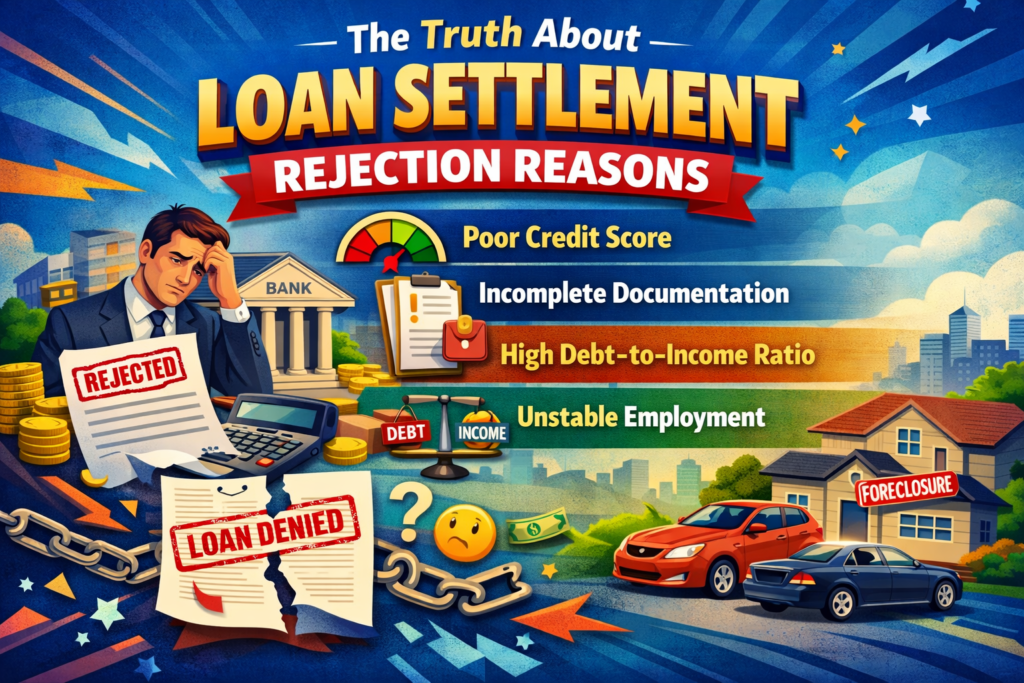
The Truth About Loan Settlement Rejection Reasons
You’ve tried everything. You gathered savings, approached your bank with a genuine settlement request, and still received that cold rejection: “OTS not approved.” Frustrating, isn’t it? We hear this every day. Loan settlement rejections aren’t the end — they are a signal that something in the negotiation or eligibility wasn’t aligned. Let’s uncover the real reasons banks reject settlements and how you can turn a “No” into a “Yes.”
Why Banks Reject Loan Settlement Offers (Real Ground Realities)
Unrealistic Settlement Amount
Banks expect 50%-80% of outstanding principal as one-time settlement. Offering too low (like 20%) triggers automatic rejection.
Inconsistent Payment History
If you made partial payments after default but not regular, the bank doubts your intent to close. They need stability.
Borrower’s Hidden Assets / Income Proof
Banks run internal checks. If they detect new assets, ITR growth, or business income, they may reject settlement & demand full dues.
Incomplete Documentation
Missing income proof, hardship letter, or bank statements delay processing. Even small mismatches lead to OTS rejection.
Legal Action / SARFAESI Already Initiated
Once the bank issues section 13(2) notice under SARFAESI, they become aggressive; settlements need specialized negotiation.
NPA Age & Bank Policies
Some lenders reject settlement if loan is less than 180 days overdue (early NPA) or too old (>3 years) without updated revival.
🎯 Our ICP Strategies: Customized Settlement Roadmap
No two debt profiles are identical. We use Ideal Customer Profile (ICP) strategies to map your unique financial fingerprint:
- Salaried professionals — negotiating based on net salary & job stability.
- Small business owners — using GST & seasonal income cycles for lower settlement ratios.
- Multiple loan burden — cluster negotiation strategy for simultaneous OTS with different banks.
- High CIBIL impact avoidance — structured closure with “settled” status but negotiated to reduce future lending block.
We don’t send templates. Each case is manually reviewed, and we prep your “defense file” that banks actually respect. That’s why our settlement approval rate is 3x higher than individual attempts.
Hidden Rejection Traps & How to Overcome Them
🔍 Rejection reason #7: Multiple loan defaults & poor prioritization — if you owe to 3+ lenders, banks sense desperation. Solution: Settle smaller loans first to reduce overall burden, then tackle the biggest one with improved leverage.
🔍 Rejection reason #8: Lack of professional representation — direct customer communication often gets lost in bank hierarchy. Our team drafts formal OTS applications, follows up with branch managers and regional debt recovery cells, ensuring accountability.
✅ Humanized tip: Never accept the first rejection as final. Banks have escalation matrices. A polite, persistent follow-up with fresh documents (medical emergency proof, business loss proof) can reopen settlement doors.
5 Steps to Turn Loan Settlement Rejection into Approval
- Audit your current financials – collect income proof, bank statements, and reason for default.
- Know bank’s OTS policy – each lender has a minimum settlement percentage (usually 40–60% of principal).
- Craft a genuine hardship proposal – include future repayment capacity.
- Approach the right authority – branch manager, then debt recovery cell, then Nodal officer.
- Partner with experts – Karaz Se Mukti Team handles end-to-end negotiation, documentation, and legal compliance.
Frequently Asked Questions (Loan Settlement Rejection)
Get Personalized Help – Free Consultation
Tired of rejection emails? Let the Karaz Se Mukti team fight for your financial freedom. One call can change your debt story.
📢 Connect with us for daily debt freedom insights:
📌 Author: KARAZ SE MUKTI TEAM – India’s trusted debt settlement advisors