
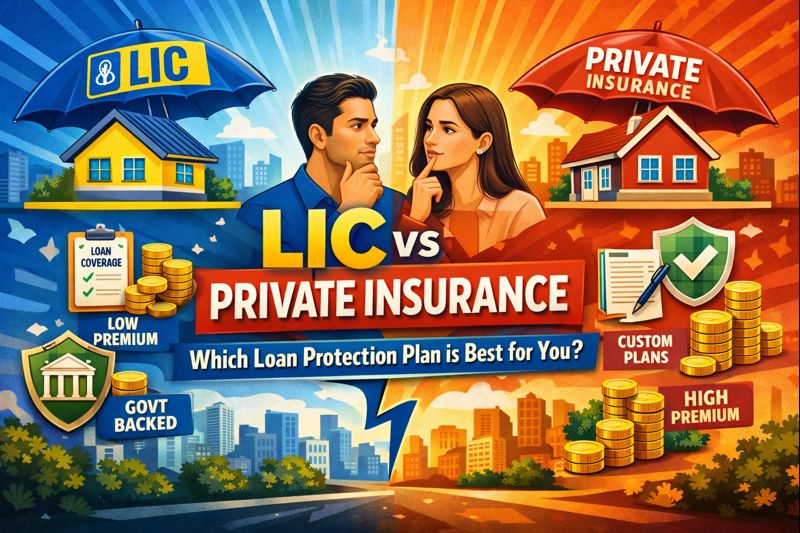
LIC vs Private Insurance: Which Loan Protection Plan is Best for You?
Are you a middle-class Indian borrower drowning in loan EMIs? Are recovery agents calling your family, visiting your home, and creating unbearable stress? You are not alone. Thousands of families in Jalandhar, Punjab, and across India face the same nightmare every day.
LIC vs Private Insurance — which loan protection plan will actually protect you and your loved ones when life gets tough? In this complete guide we compare both options with real facts, RBI guidelines, and legal rights so you can finally breathe easy.
Don’t let loan stress destroy your peace. Read till the end and discover how the right protection plan — or expert help — can change everything.
Stressed with Loan Recovery Calls?
We have helped thousands of borrowers stop illegal harassment and restructure loans legally.
📞 +91 75080 25178or mail us: info@karzsemukti.in
GET FREE CONSULTATION NOW✅ Confidential • ✅ RBI-compliant • ✅ Same-day advice
What is a Loan Protection Plan?
A loan protection plan (also called credit life insurance or loan cover) pays off your outstanding loan if the borrower dies, becomes disabled, or in some cases loses a job. It protects your family from debt burden and gives peace of mind. Banks often bundle it with home loans, personal loans, or car loans.
LIC Loan Protection Plans – The Trusted Government Option
LIC, being a government-backed insurer, is the first choice for most middle-class families. Plans like LIC’s Jeevan Arogya or term plans linked with loans offer high reliability. According to RBI guidelines, LIC policies enjoy strong claim settlement ratios (99%+ in recent years).
Pros: Extremely trustworthy, easy documentation, strong legal backing.
Cons: Slightly higher premium, slower digital process.
Private Insurance Loan Protection Plans – Modern & Flexible
Private players (HDFC Life, ICICI Pru, Max Life, Bajaj Allianz etc.) offer innovative riders including unemployment cover, critical illness, and accidental disability. Many provide instant digital issuance and faster claim processing.
Pros: Lower premium in many cases, extra covers, quick claims.
Cons: Trust level varies, claim settlement ratio slightly lower than LIC.
LIC vs Private Insurance: Head-to-Head Comparison
| Feature | LIC | Private Insurance |
|---|---|---|
| Claim Settlement Ratio | 99%+ | 95–98% |
| Trust & Government Backing | Very High | Company dependent |
| Premium Cost | Moderate to High | Often lower |
| Extra Covers (Job loss, Critical Illness) | Limited | Excellent riders available |
| Claim Process | Traditional (documents) | Fast & Digital |
| RBI Compliance & Transparency | Excellent | Good |
According to RBI guidelines, banks cannot force you to buy insurance from only their tied partner. You have the right to choose LIC or any private insurer.
7 Legal Rights to Stop Illegal Recovery Harassment
1. Right to Fair Recovery Practices
According to RBI guidelines on Fair Practices Code for Lenders, recovery agents cannot use abusive language, threats, or visit your home after 7 PM or before 7 AM. Any violation can be reported immediately.
2. Right to Privacy
Banks and agents cannot share your loan details with neighbours or relatives without written consent. This is clearly mentioned in RBI Master Directions.
3. Right to Insurance Claim First
If you have a valid loan protection plan (LIC or private), the bank must first try to settle the outstanding amount from the insurance before harassing you or your family.
4. Right to Approach Banking Ombudsman
Free, fast redressal under the Banking Ombudsman Scheme 2006 (updated). File online if your bank ignores your complaint about harassment.
5. Protection under BNS (Bharatiya Nyaya Sanhita)
Threats, intimidation or extortion by recovery agents can attract criminal cases under BNS Sections for criminal intimidation and cheating.
6. Right to Loan Restructuring
According to RBI guidelines, banks must consider genuine requests for EMI restructuring or moratorium if you face genuine financial difficulty.
7. Right to Reject Forced Insurance
You cannot be forced to buy insurance from a particular company. You can buy LIC or any IRDAI-approved private plan separately and submit it to the bank.
Still Getting Recovery Calls Despite Insurance?
Our expert team will review your LIC or private insurance policy, talk to your bank, and stop harassment legally — completely free consultation.
CALL +91 75080 25178 RIGHT NOWUrgent help available 7 days a week • Thousands already helped
Frequently Asked Questions
1. LIC vs Private Insurance: Kaunsa loan protection plan behtar hai middle-class borrowers ke liye?
LIC offers higher trust and better claim settlement, while private plans give more flexible covers at lower cost. Choose LIC if you want maximum security; choose private if you want extra riders like job-loss cover. According to RBI guidelines, you have full right to choose either.
2. Kya loan protection insurance recovery agents ko rok sakta hai?
Yes. If your policy is active and covers the event (death/disability), the bank must first claim from insurance. Illegal harassment after that can be stopped by sending a legal notice or complaining to the Banking Ombudsman.
3. RBI guidelines mein loan insurance ke baare mein kya likha hai?
According to RBI guidelines, banks cannot force you to buy insurance from only one company. They must disclose all charges clearly and follow fair practices. You can buy LIC or private plan independently.
4. LIC ka claim settlement ratio private insurers se better hai kya?
Yes. LIC consistently reports 99%+ claim settlement ratio, while most private insurers are between 95–98%. For middle-class families, LIC is considered more reliable in difficult times.
5. Agar main loan stress mein hoon toh Karz Se Mukti team kaise help karegi?
We review your loan documents, LIC or private insurance policy, talk to the bank on your behalf, stop illegal recovery, and help restructure the loan legally. Thousands of borrowers in Punjab and across India have already got relief.
6. Loan protection plan lene ke baad bhi harassment ho rahi hai toh kya karun?
Immediately contact us at +91 75080 25178. We will send a legal notice to the bank citing RBI guidelines and BNS provisions. Most cases get resolved within 7–10 days.